
Famekite / app teardown
Block Blast: the billion-install puzzle that prints money from ads
Research: Aalind TiwariCase studyOct 17, 202610 min read
A free 8×8 block puzzle → 1B+ installs → ~$127M from ads in five months → accused of rigging your losses to ad value.
Block Blast! is the free block puzzle you have probably seen a stranger playing on the metro. Nobody remembers it launching, it never had a launch campaign, and it became the most-downloaded mobile game on earth. In early 2026 it was the highest ad-earning game alive — while its in-app purchases brought in about five thousand dollars a month. Then a developer decompiled it and called the whole thing an ad harvest with a rigged gameplay loop. We did not work on Block Blast. We pulled apart every public source — including the allegations, which remain unverified — to show how the machine works, and which parts of it you should copy.
You’re getting the whole playbook:
- The quiet two-year climb to most-downloaded game on earth
- The ads-only economy: no shop, no whales, ~$5K a month from IAP
- The rigging allegation, exactly as claimed — and exactly as denied
- What to copy, and the list you must never copy
And the honest parts you can copy without a billion installs.
Whiteboard
The short version
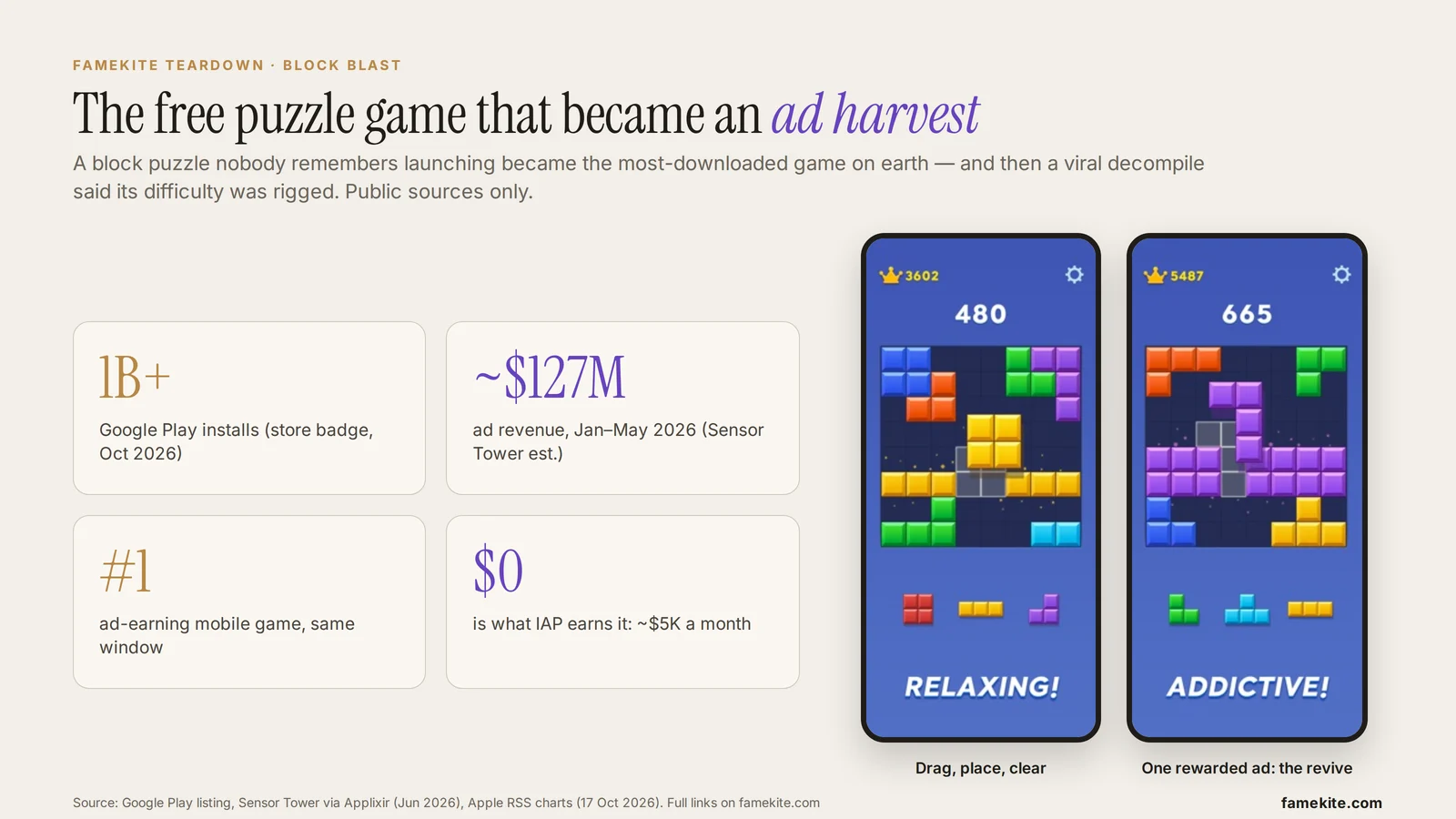
Block Blast! launched on iOS in April 2022 from Hungry Studio, a Hong Kong casual developer founded in 2021. The gameplay is not new — it descends from 1010! (2014), and the studio’s VP concedes the team “didn’t completely invent” it (Mobilegamer interview). What it added was polish, difficulty management and an unusually disciplined ad stack.
- ~$127M in ad revenue, Jan–May 2026, the most of any mobile game (Sensor Tower estimate, via Applixir). Candy Crush made ~$81M in the same window.
- ~368M installs in 2025, the most-downloaded game globally, ahead of Roblox (AppMagic estimate, Mobilegamer).
- 1B+ installs on the Google Play badge (observed on the Play listing); lifetime installs estimated 725M–868M before the badge crossed the line.
- ~$5K a month from in-app purchases — it is absent from the US top-200 grossing chart entirely (Apple grossing chart, observed). This is an ads-only business.
And since 13 October 2026, it is also the subject of a viral allegation that its difficulty is rigged to your value as an ad viewer. That claim is central to this story — and it is a claim, not a verified fact. The whole section is labelled as such.
Free access
Unlock the full guide
Enter your email and we’ll send a 6-digit code. One unlock opens every Famekite guide and tool.
- Free forever
- No newsletter
- Takes 30 seconds
Unlocked ✓
We store your name, company and email privately to give you access. No marketing emails unless you ask. Privacy details.
Who built it
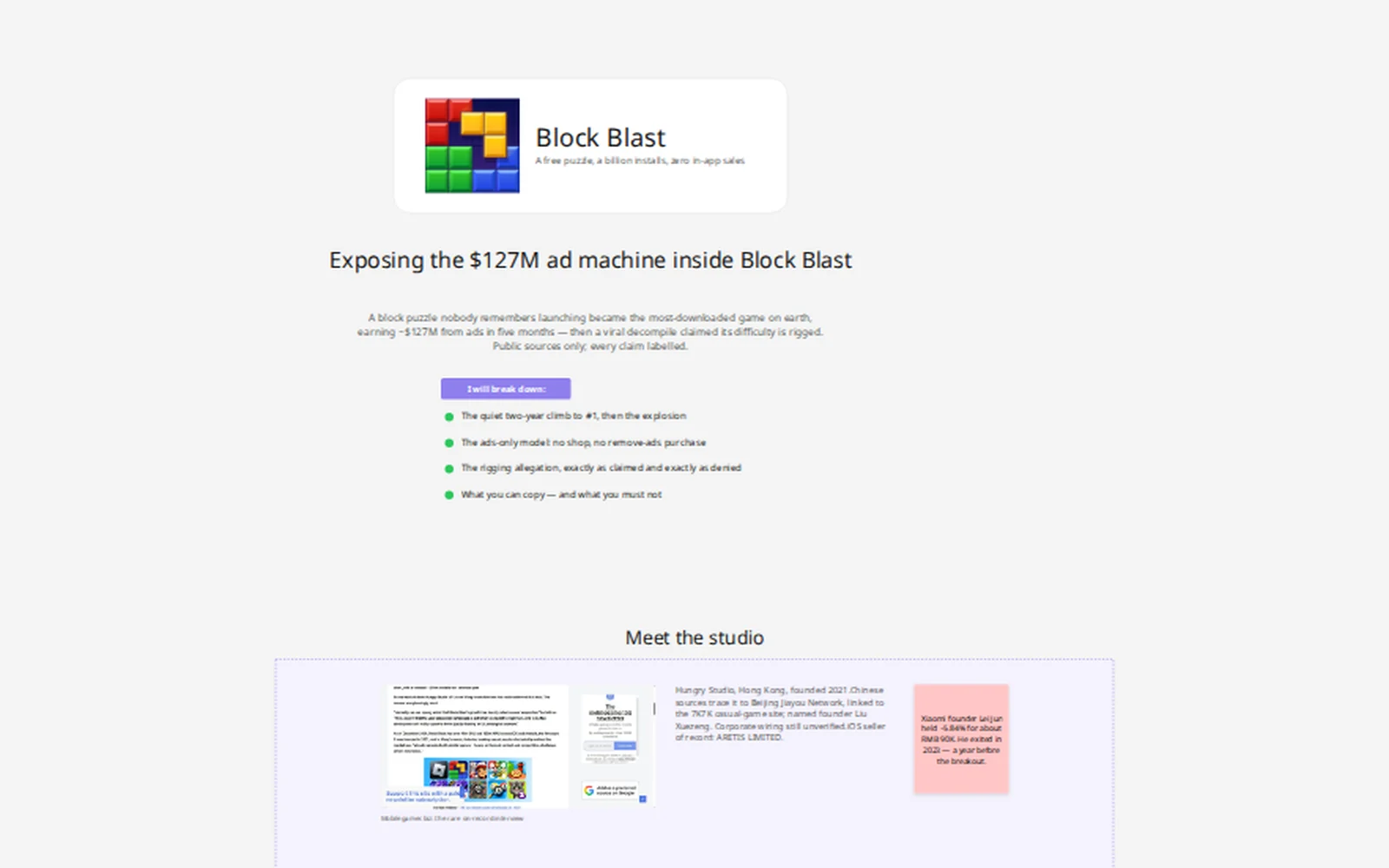
The surface story is simple: Hungry Studio, Hong Kong, founded 2021, one deliberate bet on a single polished puzzler rather than a portfolio (Mobilegamer). The iOS seller of record is ARETIS LIMITED; Google Play lists the publisher as HungryStudio.
Chinese sources add a layer: they identify Hungry Studio as the overseas brand of Beijing Jiayou Network Technology, a company tied to the 7K7K casual web-game site, with founder Liu Xuezeng described as a 7K7K veteran who pivoted to global casual apps in 2021. One curiosity: Xiaomi founder Lei Jun personally held about 5.84% of the parent for roughly RMB 90,000 — and exited in 2023, a year before the explosion. None of this corporate wiring is confirmed by the studio; treat it as reported, not established.
What is established: the studio shipped Block Blast! on iOS on 3 April 2022 and on Android that September, and spent two years climbing quietly — about 200M lifetime installs by early 2024 (GameLook).
The download timeline
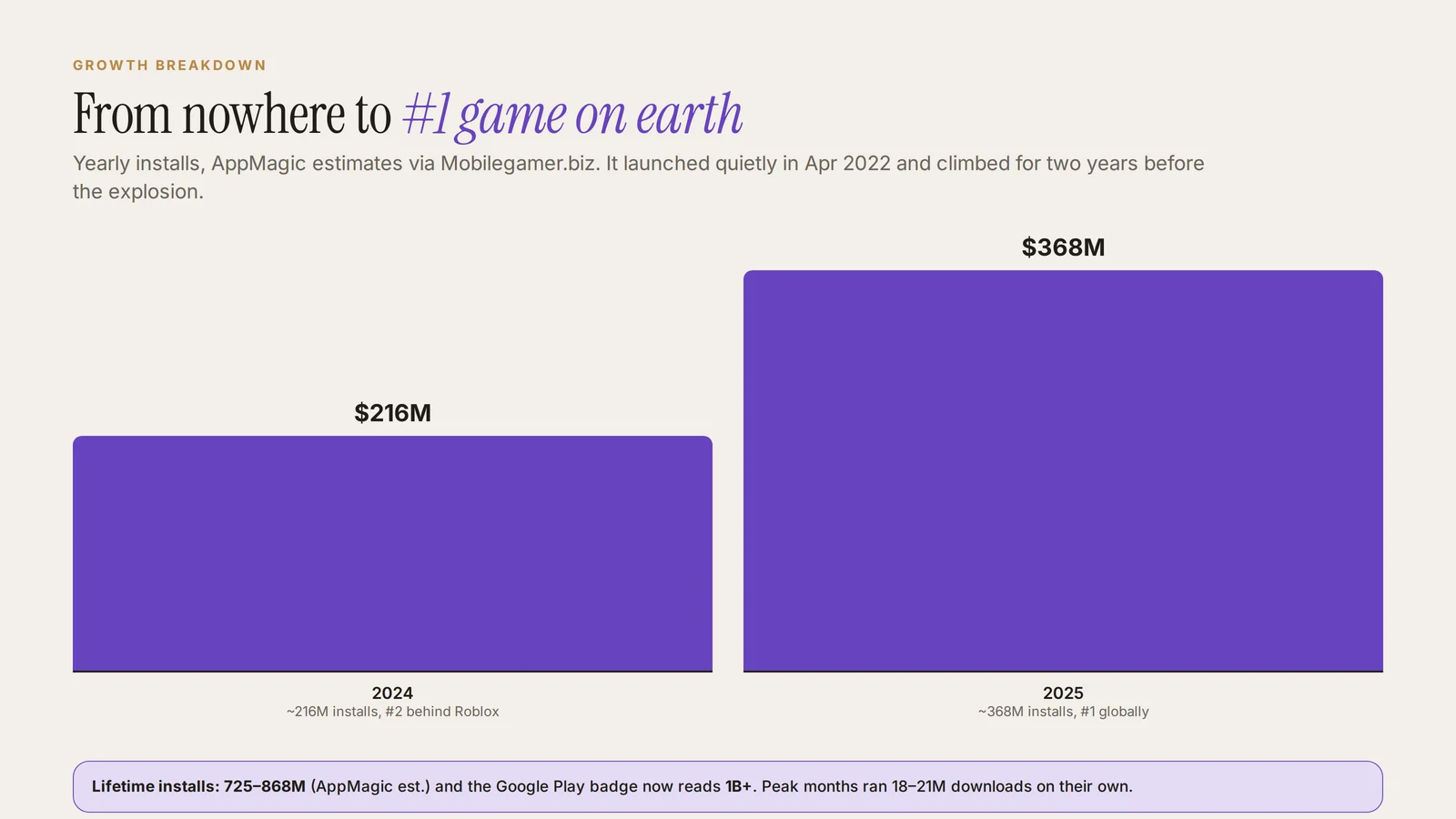
Monthly download milestones, third-party estimates unless noted.
| When | What | Detail | Source |
|---|---|---|---|
| 3 Apr 2022 | iOS launch | No fanfare, no launch campaign | App Store listing |
| 23 Sep 2022 | Android launch | Google Play release | Google Play listing |
| 2023 | ~200M installs | A slow climb, "not an overnight hit" | GameLook |
| Jan 2024 | ~20M in the month | #3 globally behind Royal Match and Roblox | GameLook |
| 2024 | ~216M installs | #2 for the year, behind Roblox | Mobilegamer |
| Dec 2024 | 21M in the month | Most-downloaded game worldwide that month | Appfigures |
| Feb 2025 | #1 US iOS programmatic | ~$7M open programmatic ad revenue in the month | Pixalate |
| Jul 2025 | 19M installs | #2 behind Roblox again | Appfigures |
| 2025 | ~368M installs | #1 game globally for the year, ahead of Roblox | Mobilegamer |
| 26 Feb 2026 | Tencent talks | Bloomberg: talks for a small stake | Business Times |
| Jan–May 2026 | ~$127M ad revenue | #1 ad-earning mobile game | Sensor Tower via Applixir |
| 13 Oct 2026 | The rigging reel | 16.6M plays in four days | the reel |
| 17 Oct 2026 | Still #7 US free game | Play badge reads 1B+ installs | Apple charts |
The user base scaled with it: 40M+ daily and 160M+ monthly active users by December 2024 (studio-stated, Mobilegamer), and the studio’s own site claimed 70M daily / 300M+ monthly by end-2025 (via Business Times). Sensor Tower counted 181M monthly actives among ad-monetized titles in May 2026 (via Applixir). Founder-stated versus third-party — both are estimates of a private company’s numbers.
The ads-only economy
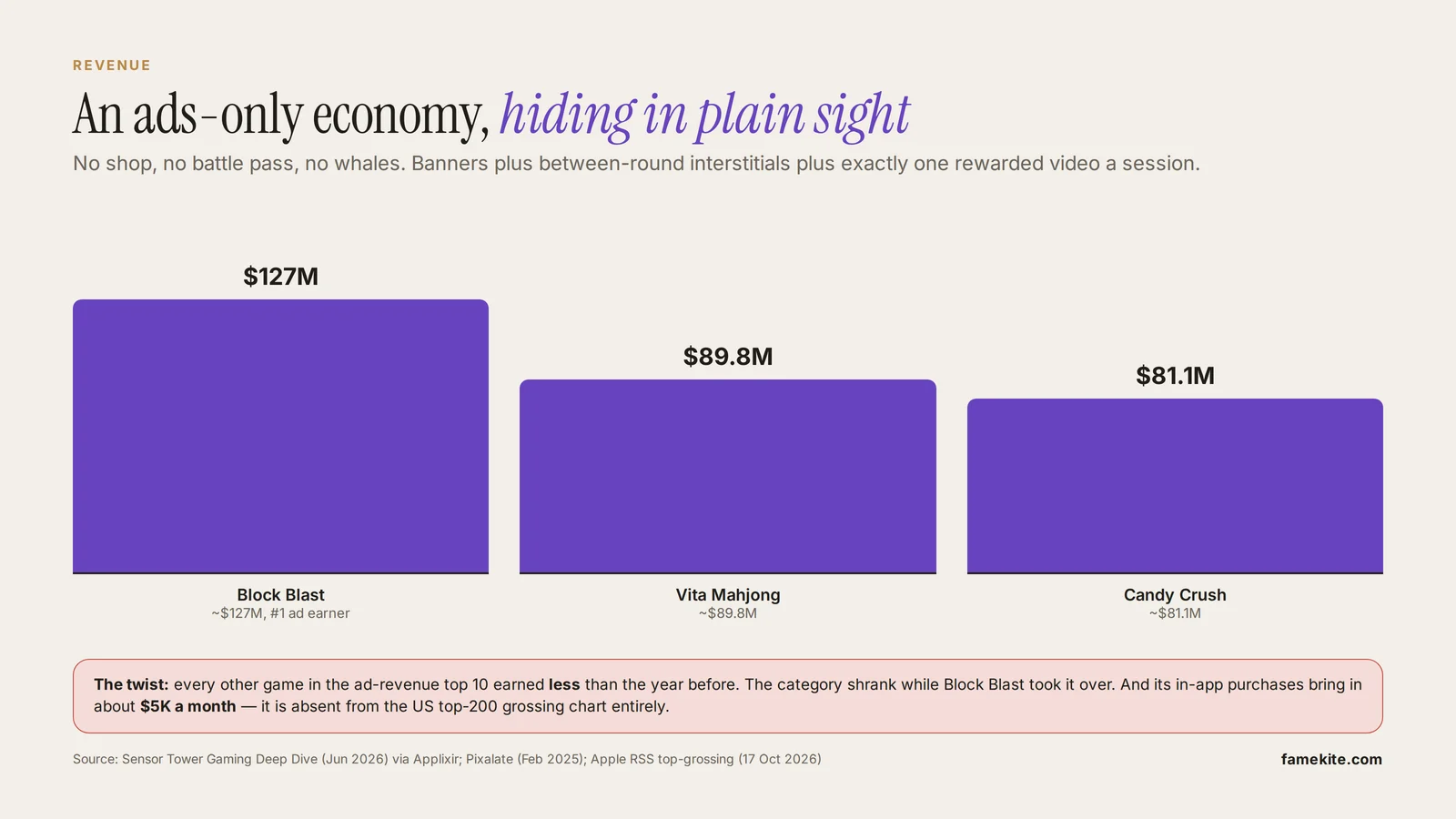
Almost every mobile game that earns this much does it with a shop. Block Blast! has none: no shop, no battle pass, no whale economy, and not even a “remove ads” purchase — despite years of player requests. There are token in-app purchases ($4.99–$49.99) on the listings, but they contribute almost nothing: roughly $5K a month against ~4M monthly downloads on the public Sensor Tower overview.
Everything else is ads, and the numbers are large:
- ~$127M ad revenue, Jan–May 2026 — the top ad-earning game, publisher total ~$131M with about 60% of it outside the US (Sensor Tower via Applixir).
- ~$7M in one month from US App Store open programmatic alone, #1 ahead of every other app (Feb 2025, Pixalate).
- “~$1M a day” at the 40M-DAU stage, per a Sensor Tower-based write-up (Gamigion) — consistent with the 2026 run-rate.
The detail that should stop you: in that Jan–May 2026 window, every other game in the ad-revenue top 10 earned less than the year before (Applixir). The category shrank, and Block Blast took it over. Puzzle games are 53% of all game ad revenue; the block sub-genre alone is 10% of it.
The allegation: a rigged loop
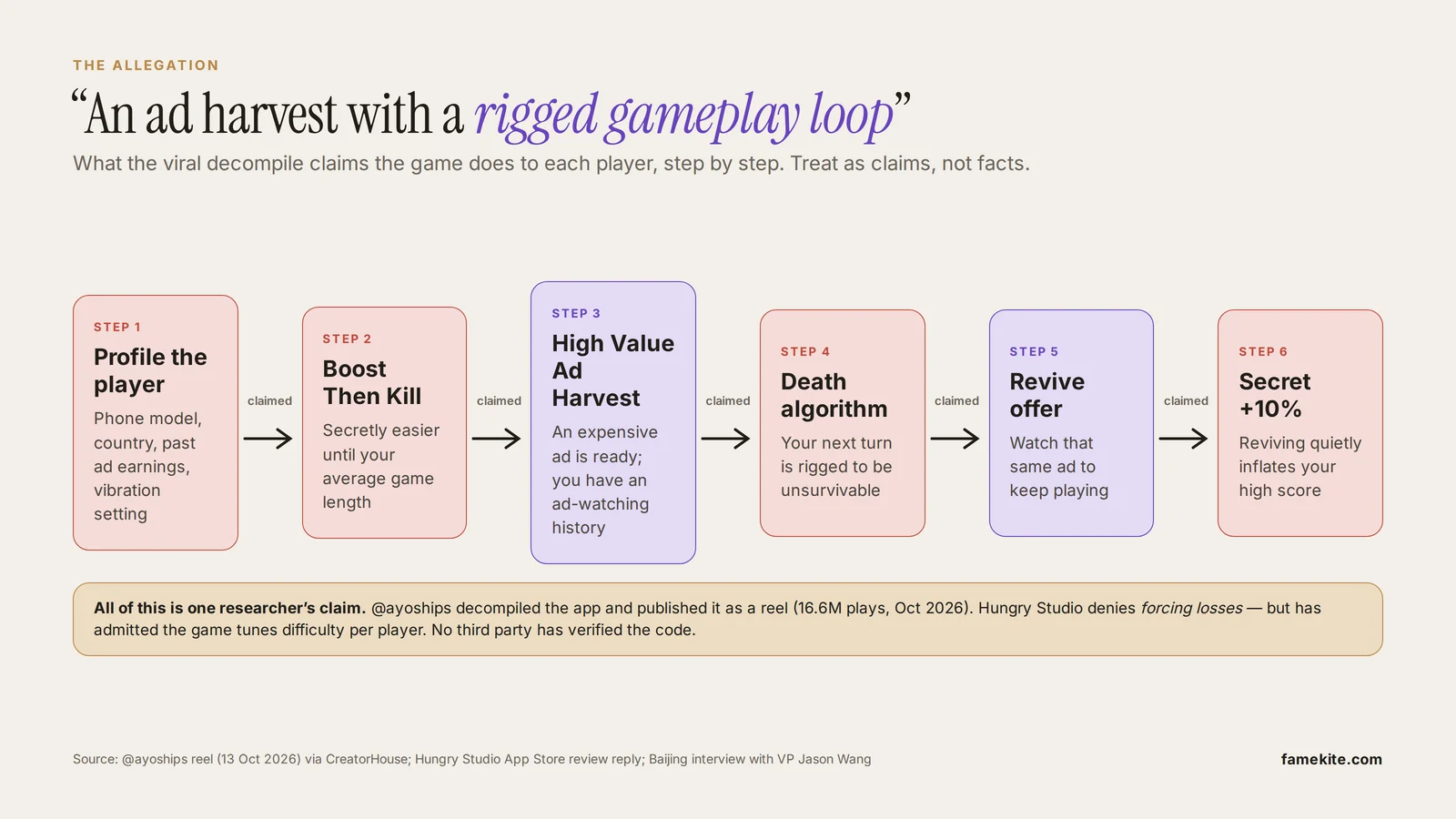
On 13 October 2026, a developer who posts as @ayoships (Ayomide Omolewa, co-founder of a0.dev) published a reel decompiling Block Blast! — 16.6M plays, 1.3M likes, 10.2K comments in four days (the reel; stats per CreatorHouse’s tracker). His thesis: “how well you do in the game has less to do with your skill and more to do with how much you’re worth to them in ads.”
Everything in this section is his claim, not a verified fact. The mechanics he alleges, in his own framing:
- Player profiling: the game reads your phone model, country, past ad earnings, even whether you disabled vibration.
- “Boost Then Kill”: the game secretly runs easier until you hit your average game length — so every session feels like your best run, right until it ends.
- “High Value Ad Harvest”: when an expensive ad is ready and you have an ad-watching history, the game helps you beat your high score — then triggers a “death algorithm” that rigs your next turn so there is no way to survive.
- The revive: the first thing you see on losing is an offer to revive by watching that same ad — and reviving secretly adds 10% to your high score, so you keep coming back.
He shows decompiled fragments on screen (an a("entry_point", …) telemetry call, a daysSeen variable, a Global((i+1)%4, …) expression). No third party has verified them: the full write-up was still unpublished as of 17 October 2026, and press summaries are summaries of the reel (Marketing Herald, Minimachines).
What the studio has actually said: a templated App Store review reply — the block algorithm “is designed to increase challenge and keep things engaging, not to force a loss” (App Store review response). Note what that denies, and what it does not: the VP has separately acknowledged automated difficulty adjustment (Mobilegamer). “We tune difficulty per player” and “we rig deaths to ad value” are very different claims; only the first is confirmed.
Independent colour, not proof: years of r/blockblast posts describe exactly this pattern — generous pieces early, impossible sets after high combos. A 2024 Hungarian academic paper had already used the game’s revive-by-ad loop as a dark-pattern example (doi.org). And sceptics raise fair counterpoints: decompiling is legally contested, the claimant is himself an app builder monetising exposure, and no one has replicated the finding (MetaFilter discussion). The honest position: alleged, plausible to its audience, unverified.
The ad architecture (the copyable part)
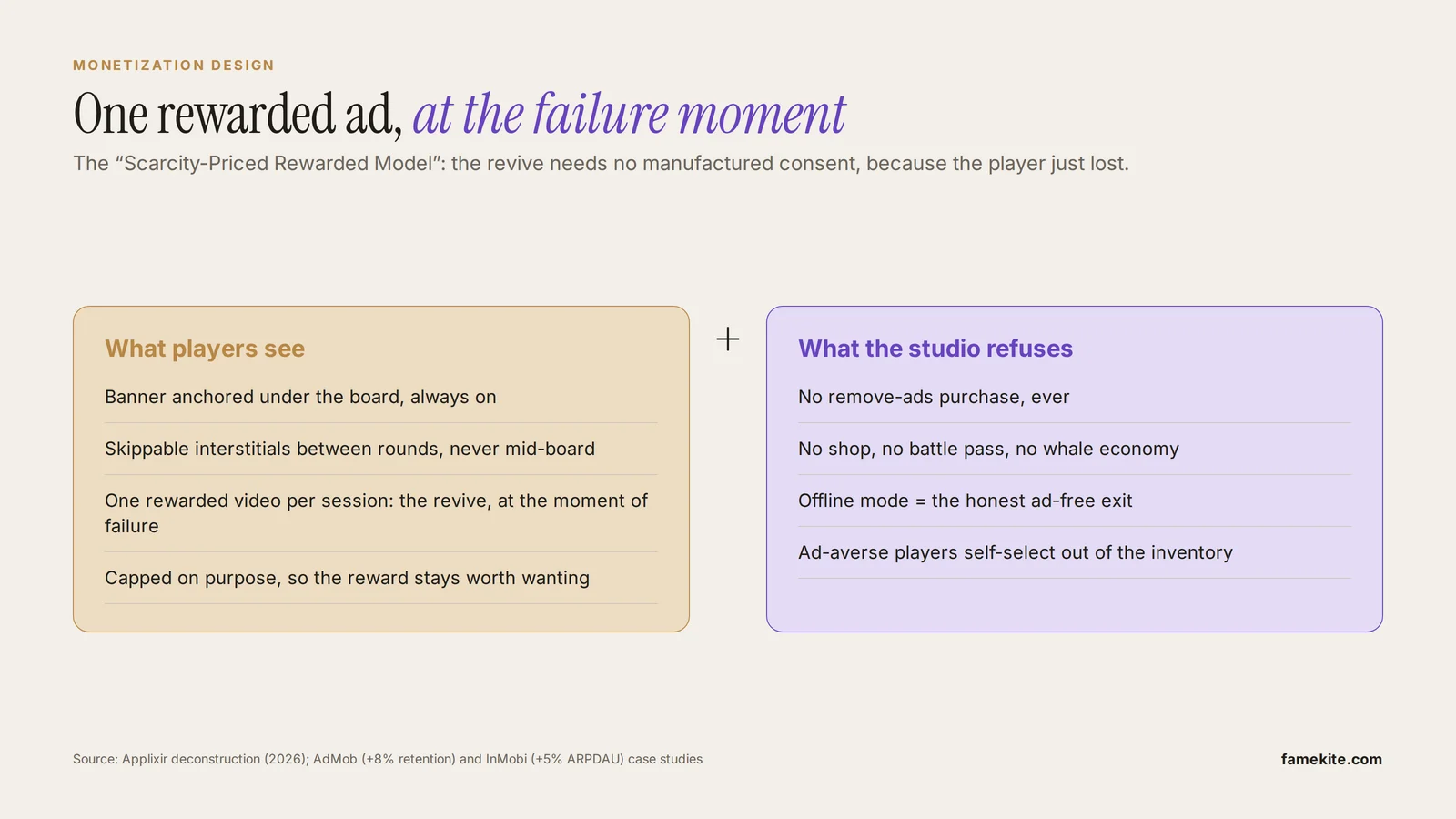
Strip out the allegations and the verified design is still worth studying. Three placements, each with a discipline most apps lack:
- Banners anchored under the board — permanent inventory that never interrupts play.
- Interstitials only between rounds, never mid-board, and skippable.
- Exactly one rewarded video per session: the revive, offered at the moment of failure. Capped on purpose, so the reward stays worth wanting.
And the piece nobody copies: offline mode is the honest exit. Ad-averse players self-select out of the inventory instead of being farmed — which is presumably why there is still no remove-ads purchase (Applixir deconstruction).
The vendors published the numbers: AdMob’s case study credits format and UX work with +8% user retention; InMobi’s with +5% ARPDAU moving from banner-only to interstitial + rewarded (both via Applixir). Retention went up while ad load was tuned — that is the whole trick.
Product design: a low floor, a high ceiling
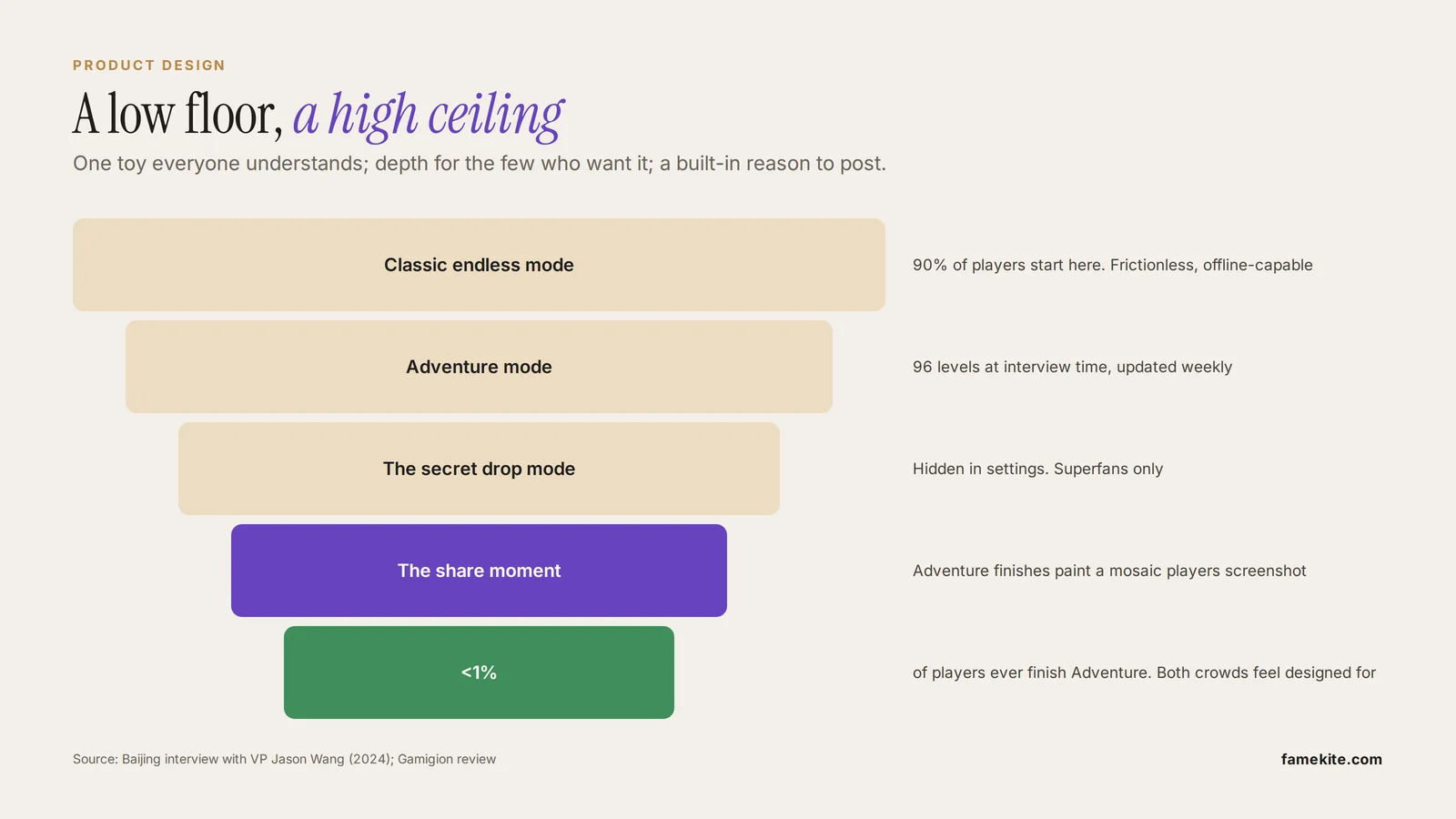
One toy everyone understands — drag three pieces onto an 8×8 grid, clear lines — with depth for the few who want it: a Classic endless mode that about 90% of players never leave, an Adventure mode (96 levels at interview time, updated weekly), and a secret “drop” mode buried in settings for superfans (Mobilegamer, Gamigion).
Adventure endings paint a mosaic on the board — which players screenshot and post. The studio’s VP describes growth as “organic adoption, strong community momentum, and long-term brand building — not advertising alone” (Gamesforum interview). An unaudited marketing claim, but the share moment is real and visible.
Distribution beyond the ad networks
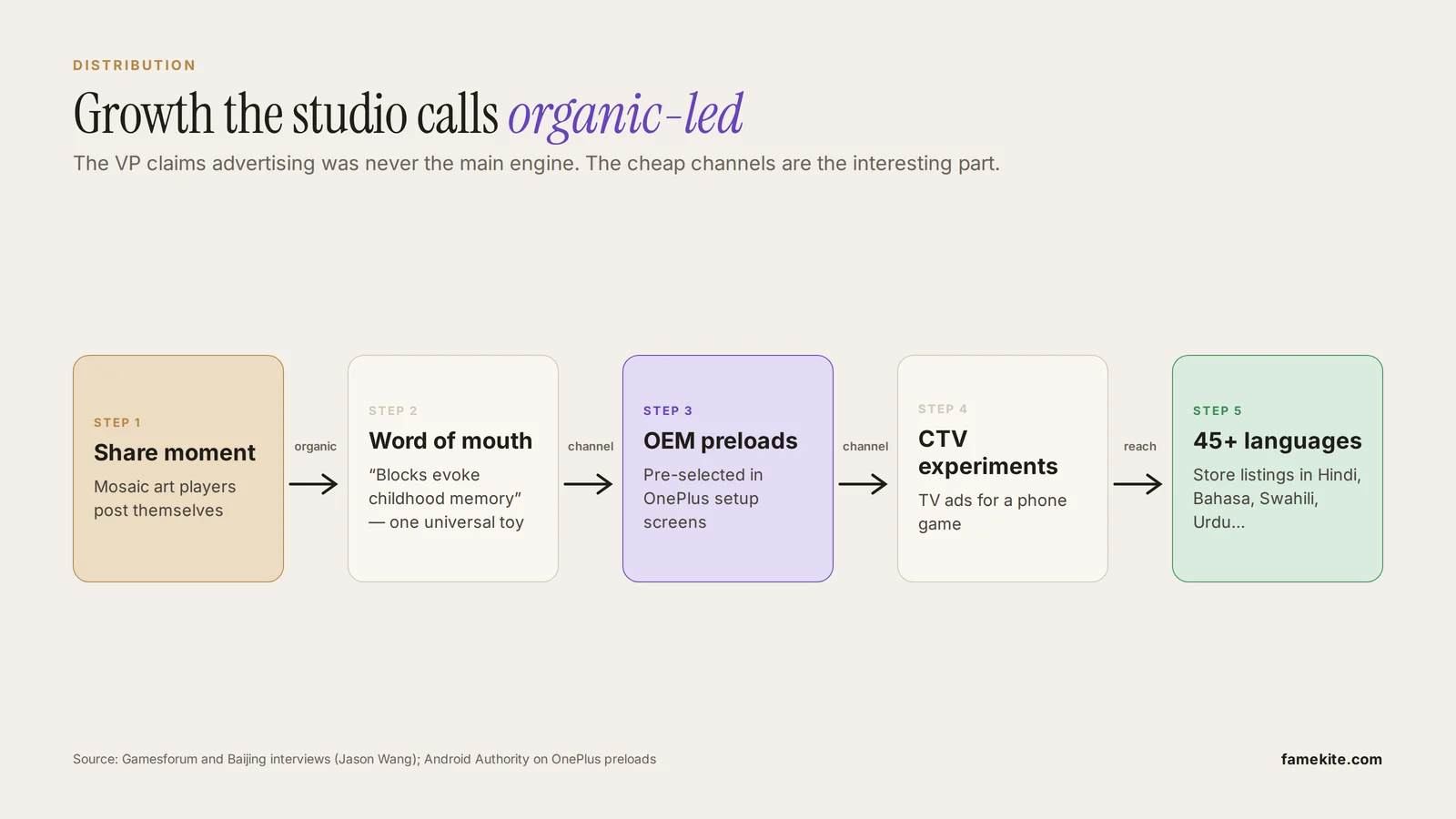
The boring channels are the interesting part. Block Blast! ships pre-selected in OnePlus flagship setup screens alongside Candy Crush (Android Authority) — a distribution channel most app marketers never touch. The studio experimented with connected-TV ads for a phone game (Mobilegamer). Store listings run in 45+ locales including Hindi, Bahasa, Swahili and Urdu, and the download base reflects it: Indonesia, the US, Vietnam, Brazil and India (Mobilegamer). Offline play is a headline listing feature in emerging markets. There is even reported NYC subway advertising (MetaFilter).
Sensor Tower’s own read on why it holds the top spot in 2026: “creative promises that matched the actual product” — honest creative that retained instead of burned (via Applixir). An ad-monetized game winning on honest ads is the irony worth sitting with.
What went wrong
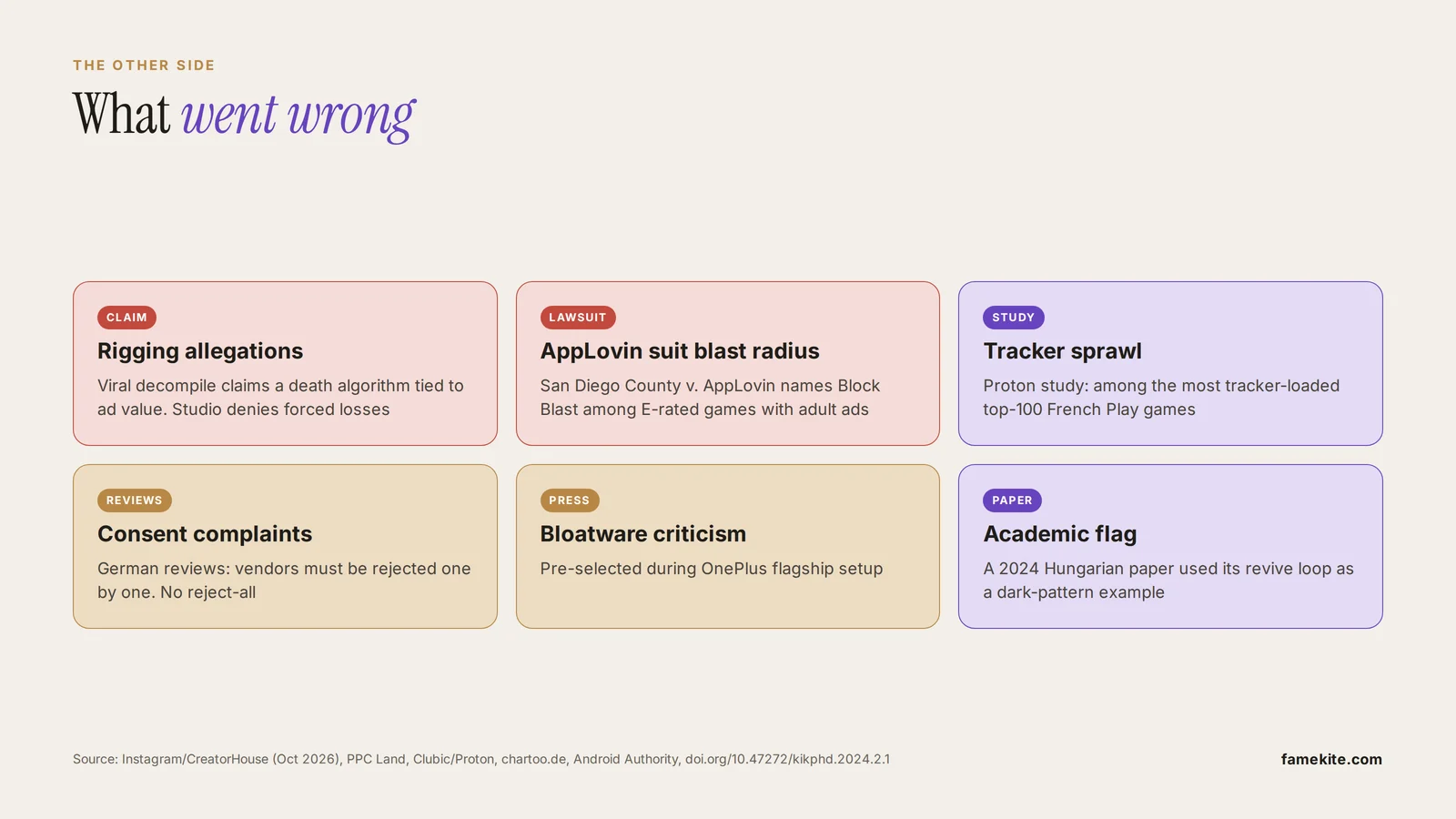
A fair teardown includes the costs — beyond the rigging allegation itself:
- The AppLovin lawsuit’s blast radius. San Diego County’s suit over adult ads shown to children names Block Blast! among E-rated games built on AppLovin’s MAX SDK (PPC Land). Hungry Studio is not the defendant — but it is in the blast radius.
- Tracker sprawl. A Proton study of the top-100 French Google Play games counts it among the most tracker-loaded (Clubic/Proton).
- Consent-flow complaints. German reviews describe a dark pattern: vendor preferences must be rejected one by one, with no reject-all button (review mirror).
- Bloatware criticism for the pre-selected OnePlus installs (Android Authority).
- An academic flag predating the reel: the 2024 Hungarian paper on unfair practices toward children (doi.org).
None of these is a court finding against the studio. Together they are a picture of what an ads-only machine drags behind it — and a reminder that the reputational bill arrived in one viral week.
What you can copy, and what you must not
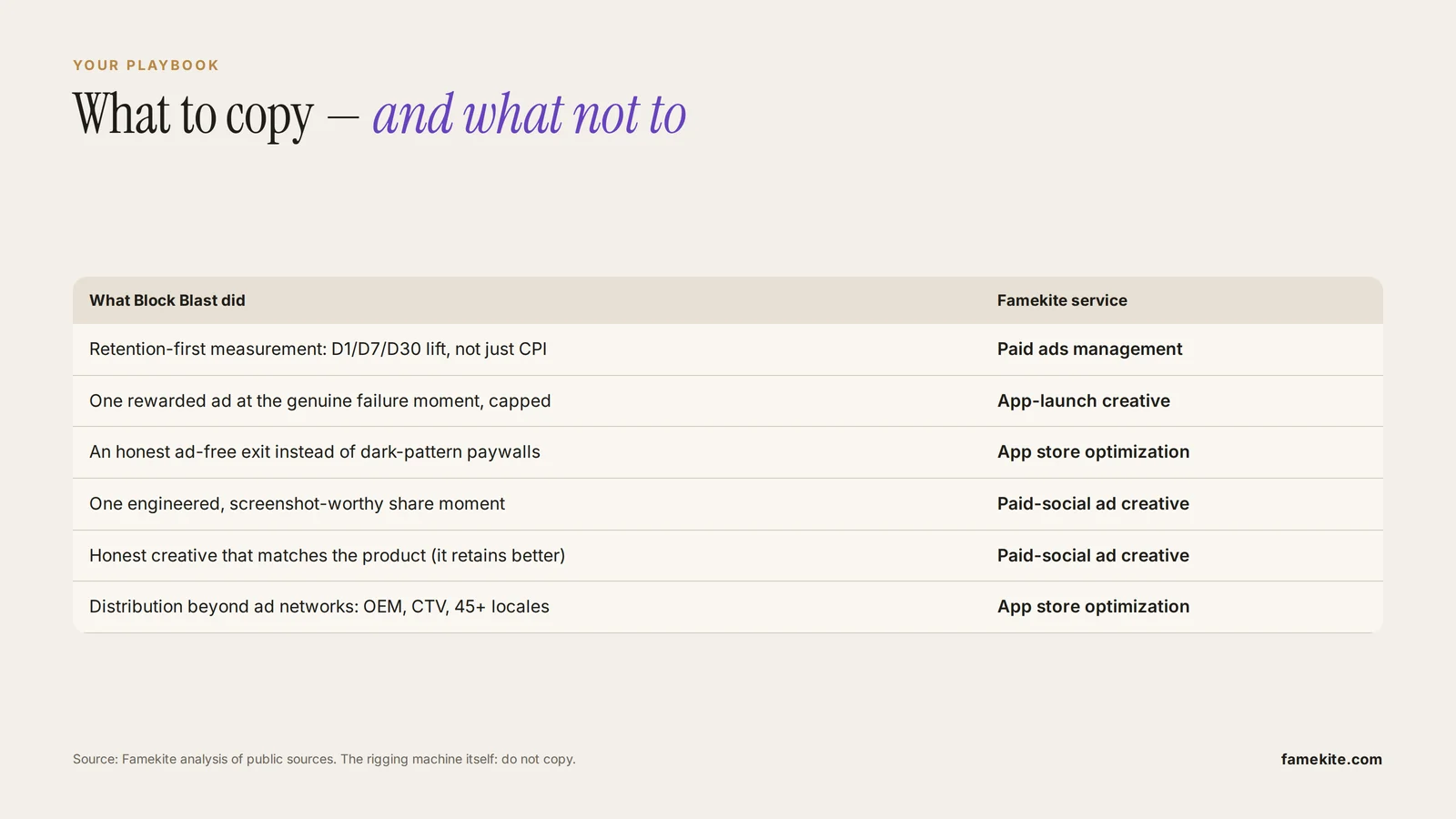
The legal, ethical parts of this playbook are genuinely good and genuinely rare:
| Lesson | Where Famekite helps |
|---|---|
| 1. Measure retention (D1/D7/D30 lift) before you measure CPI. Retention is the monetization. | Paid ads management |
| 2. Place one rewarded ad at the genuine failure moment, and cap it. Scarcity is what keeps it welcome. | App-launch creative |
| 3. Position honestly: an ad-free exit and no dark patterns beat paywall tricks. | Paid-social ad creative |
| 4. Engineer one screenshot-worthy share moment into the product itself. | Clipping agency |
| 5. Keep creative honest: Sensor Tower credits matching promises with the retention that carried it. | UGC and influencer content |
| 6. Look past ad networks for distribution: OEM preloads, CTV, 45+ store locales. | App store optimization |
And the do-not-copy list, because it needs saying plainly: no profiling players by ad value, no engineered loss loops, no “death algorithms,” no secret score inflation, no consent screens without a reject-all. Beyond ethics, they are now litigation and press risk — the reel proved a single researcher can reach 16.6M people in four days with your decompiled code on screen. If difficulty bends to ad value, that is not retention. It is theft of trust, and it eventually gets found.
For the full visual breakdown — evidence screenshots, the claimed loop, the ad architecture — see the Block Blast teardown board on Miro.
Want this working on your app?
Famekite builds the creative engine behind growth like this: ad concepts, UGC and clipping, tested with the same discipline. Book a 15-minute call and we will map what to copy first for your app.
Before you brief us
Did Famekite work on Block Blast?
No. This is an independent teardown built only from public sources: store listings, third-party estimates, press and the decompile reel. Every figure links to its source, and every claim is labelled as founder-stated, estimated, reported or unverified.
Is Block Blast actually rigged?
Unverified. The rigging mechanics come from one researcher’s decompilation, published as a viral reel; the studio denies forcing losses but acknowledges per-player difficulty tuning. No third party has replicated the code evidence, and no court has ruled. We present the claim, the denial and the caveats side by side.
How does a free game with no shop make $127M?
Volume times discipline: 1B+ installs and tens of millions of daily players, a banner, between-round interstitials, and exactly one capped rewarded ad (the revive) placed at the failure moment. The absence of a remove-ads purchase is deliberate — offline mode already serves ad-averse players.
Are the revenue numbers audited?
No. They are Sensor Tower and Pixalate estimates, plus studio-stated user figures — a private company’s claims. Different trackers disagree on details (one outlier even claims a majority of revenue is IAP, contradicting the store charts); we anchor on the consensus and label everything.
Free download
Want the worksheets?
Six editable planning tools (brief, script, editor handoff, test planner, launch map, publishing checklist) in one free ZIP.
More free guides
A clear next step
Bring the goal. We’ll discuss the scope.
Share your audience, existing assets and the job you need the creative to do. Deliverables, timing, revisions and any media budget are agreed before work starts.