
Famekite / app teardown
How Cal AI went from $0 to $5.7M a month, mostly on creators
Research: Aalind TiwariCase studyOct 14, 20268 min read
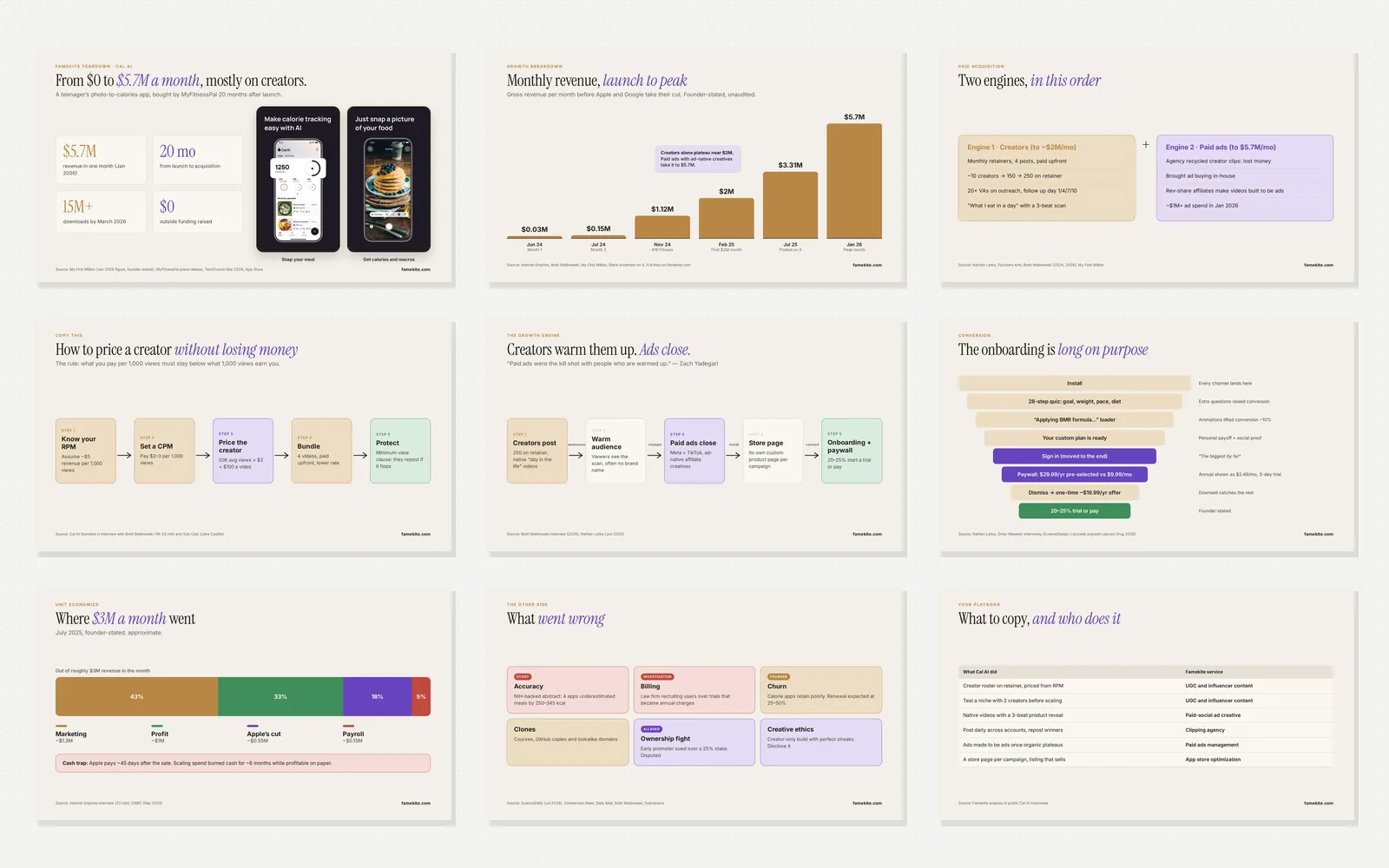
$0 raised → $5.7M in one month → bought by MyFitnessPal. Built by a teenager.
A teenager built a calorie app you use by photographing your food. Twenty months later it made $5.7M in a single month and the market leader bought it. We did not work on Cal AI. We pulled apart every public interview, post and store listing to show how the growth actually worked, and which parts you can copy.
You’re getting the whole playbook:
- The creator roster that got them to $2M a month
- The pricing math they used to pay creators
- The onboarding and paywall that turned installs into trials
- What went wrong: accuracy, billing and a lawsuit
And the parts you can copy without their budget.
Whiteboard
The short version
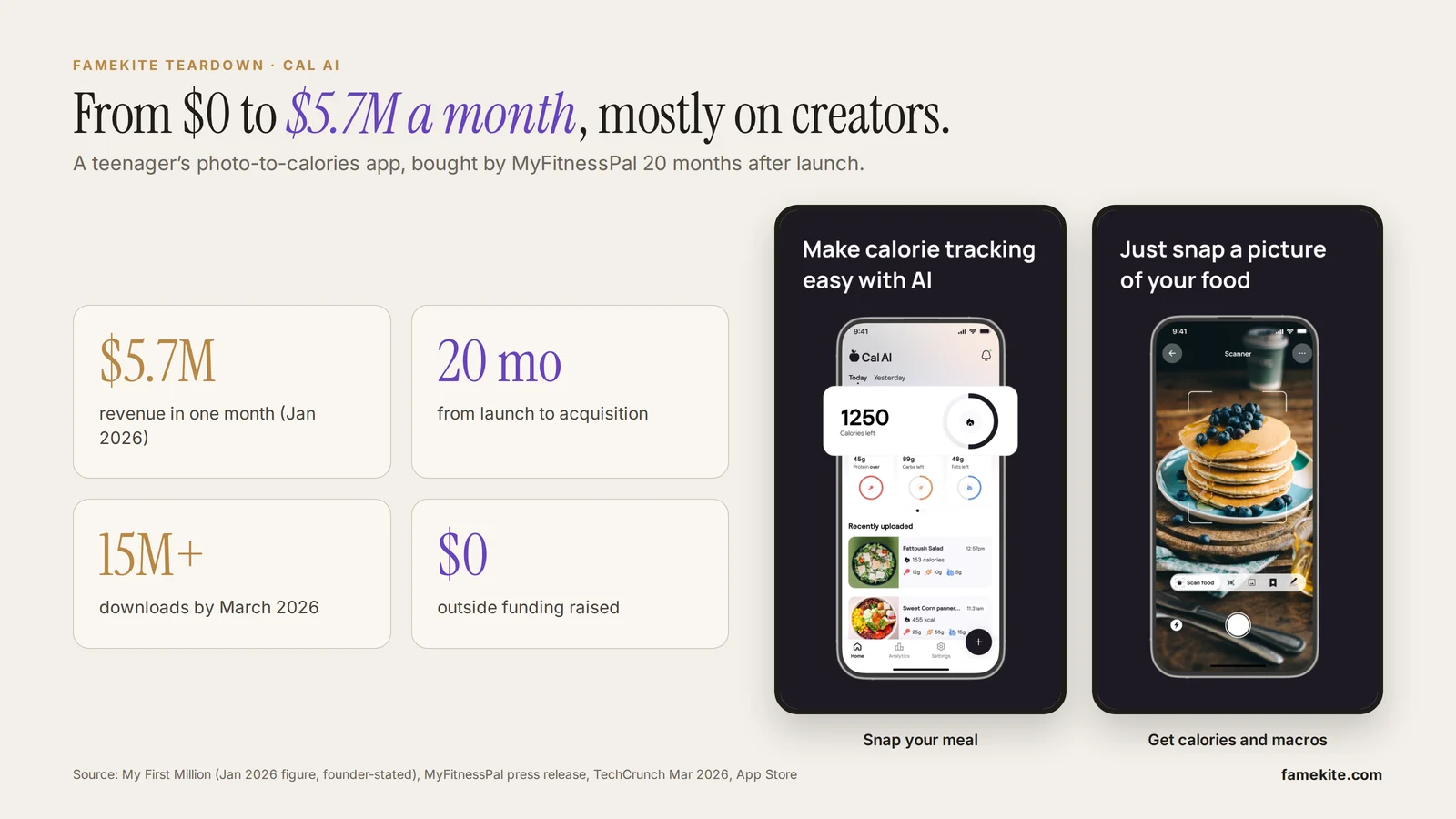
Cal AI launched in May 2024 with one feature: point your phone at a meal and get the calories and macros back. Its founders were Zach Yadegari and Henry Langmack, high-school friends, and Blake Anderson, who had already built viral apps such as Umax. They raised no outside money (Forbes).
- $5.7M in one month (January 2026), founder-stated (My First Million).
- Over $40M in sales in the 12 months before it was acquired, and 15M+ downloads (MyFitnessPal press release, TechCrunch).
- Bought by MyFitnessPal. Closed December 2025, announced March 2026. The price was never disclosed. You will hear "about $100M"; that is a podcast host's guess, not a reported figure.
The interesting part is the order of the engines. Creators alone took them to about $2M a month, and then growth flattened. Paid ads were the second engine, and they only worked once the creative changed.
Free access
Unlock the full guide
Enter your email and we’ll send a 6-digit code. One unlock opens every Famekite guide and tool.
- Free forever
- No newsletter
- Takes 30 seconds
Unlocked ✓
We store your name, company and email privately to give you access. No marketing emails unless you ask. Privacy details.
Why it was built to be filmed
The insight was small and specific. Zach quit a mainstream calorie app after three days because weighing and typing every meal was "unsustainable" (CNBC). Taking a photo takes a few seconds, and you can watch it work on camera.
That matters more than it sounds. The value of Cal AI is visible in under three seconds of video: food, scan, numbers. Most apps need a voiceover to explain themselves. This one did not, which made it a perfect product for creators to show without it feeling like an ad.
It was also cheap. Cal AI charged about $30 a year against roughly $80 to $120 for incumbents, and MyFitnessPal's CEO later described it as the app "for those preferring speed over accuracy" (TechCrunch).
The first 1,000 users
- The first ~100 came from Zach's own TikToks (founder interview).
- The first ~1,000 came from fitness creators posting Instagram Stories, not Reels. Stories are cheap, carry a link and let you test a niche quickly. They validated it with two creators.
- Cold outreach at volume. Roughly one creator in a hundred replies to a DM. Opening with "paid promo" made the message show up in the inbox preview (My First Million).
- About ten creators on retainer after month one, four posts each a month, growing every month after that.
The revenue timeline
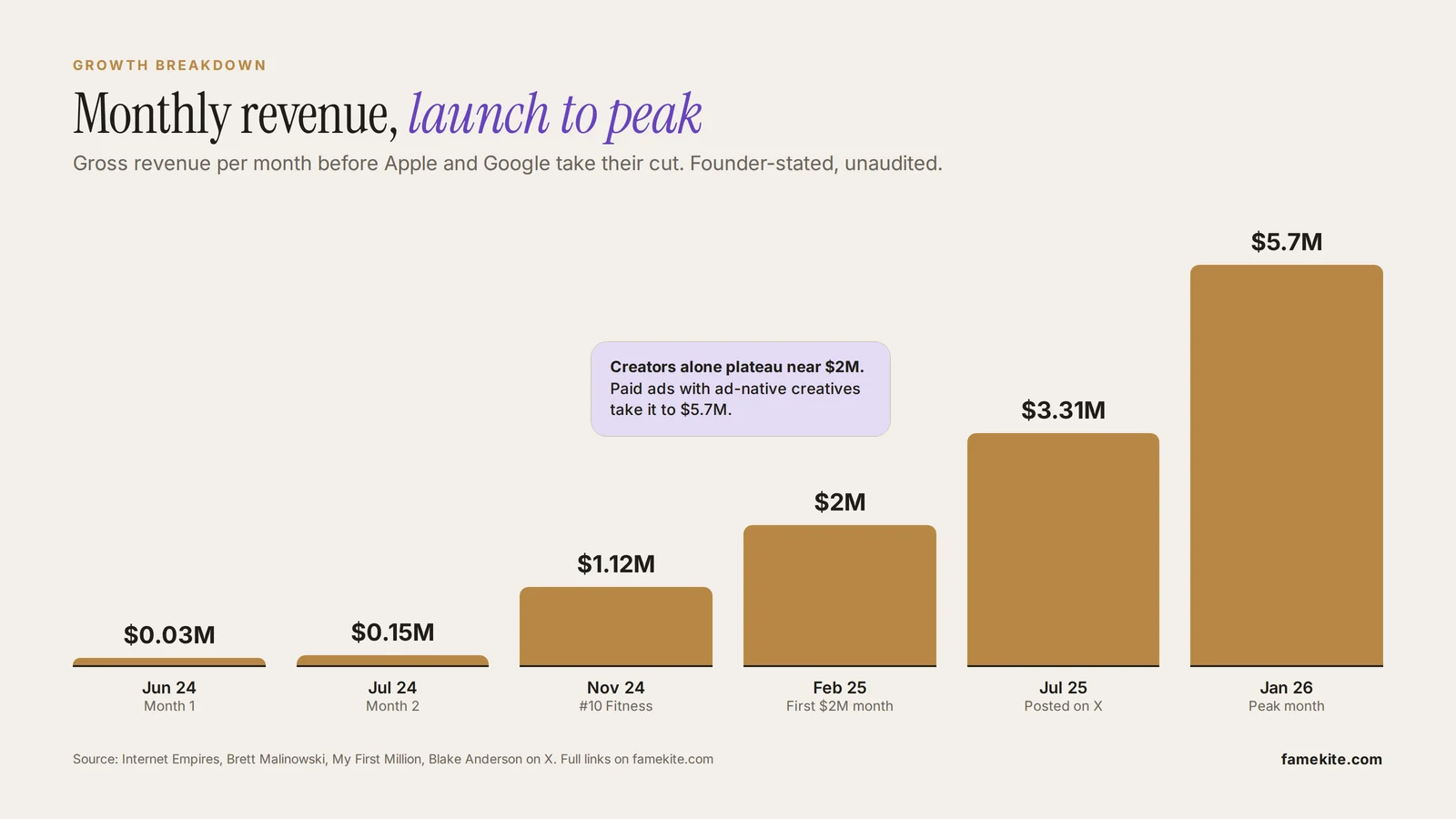
Gross monthly revenue before Apple and Google take their cut, as stated by the founders unless noted.
| Month | Revenue | Milestone | Source |
|---|---|---|---|
| Jun 2024 | about $30K | Month one | Internet Empires |
| Jul 2024 | about $150K | Month two | Internet Empires |
| Nov 2024 | about $1.12M | #10 in Health & Fitness | Brett Malinowski |
| Feb 2025 | $2M+ | First $2M month, 15 staff | My First Million |
| Jul 2025 | $3.31M | Co-founder posts the number | Blake Anderson on X |
| Jan 2026 | $5.7M | Peak month, about $50M run rate | My First Million |
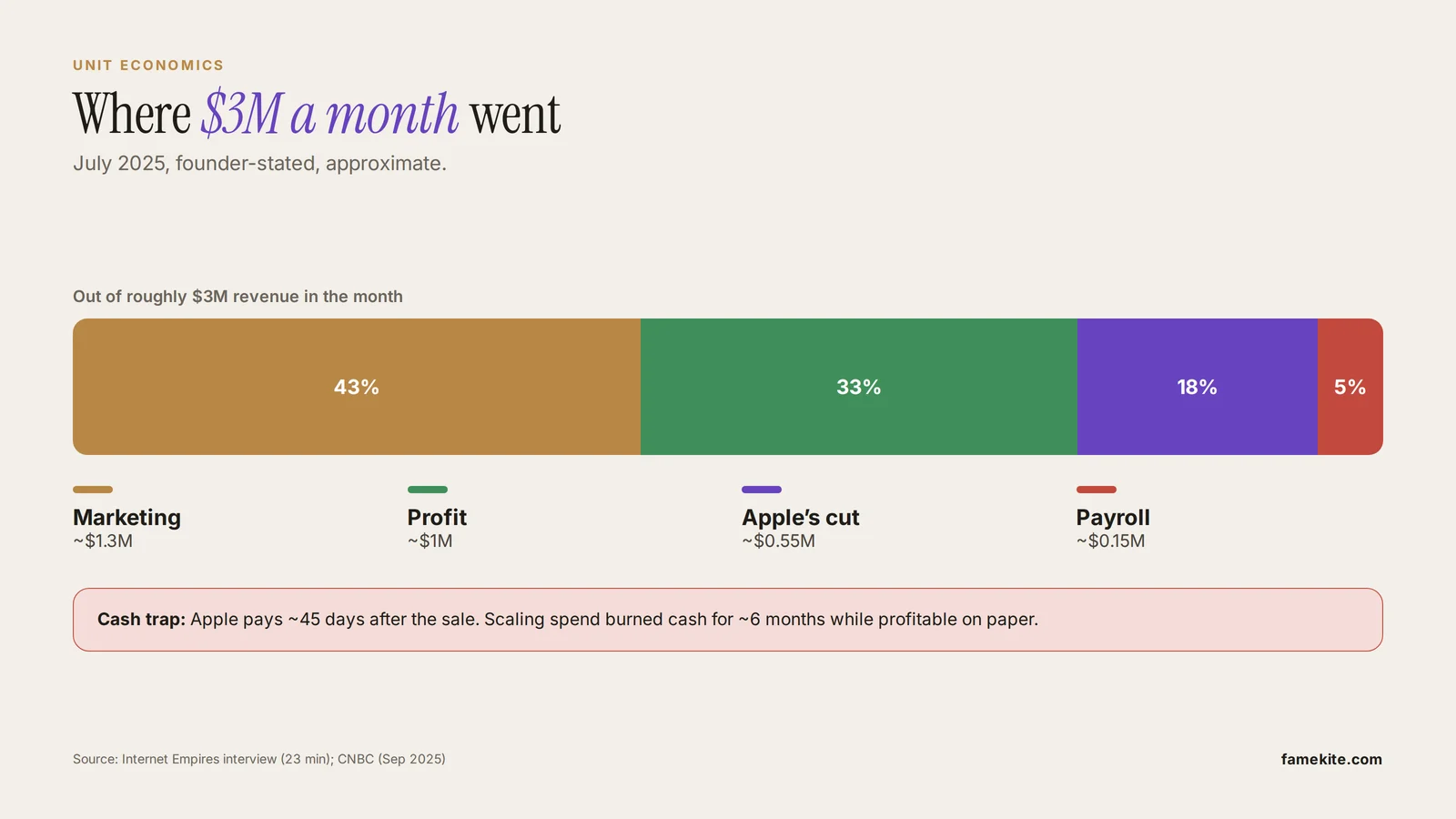
One breakdown worth knowing: in July 2025, out of roughly $3M in the month, about $1.2M to $1.4M went on marketing, about $1M was profit and payroll was $100K to $200K (Internet Empires). Apple pays about 45 days after a sale, so scaling spend burned cash for about six months even while the business was profitable (CNBC).
Engine one: a creator roster on retainer
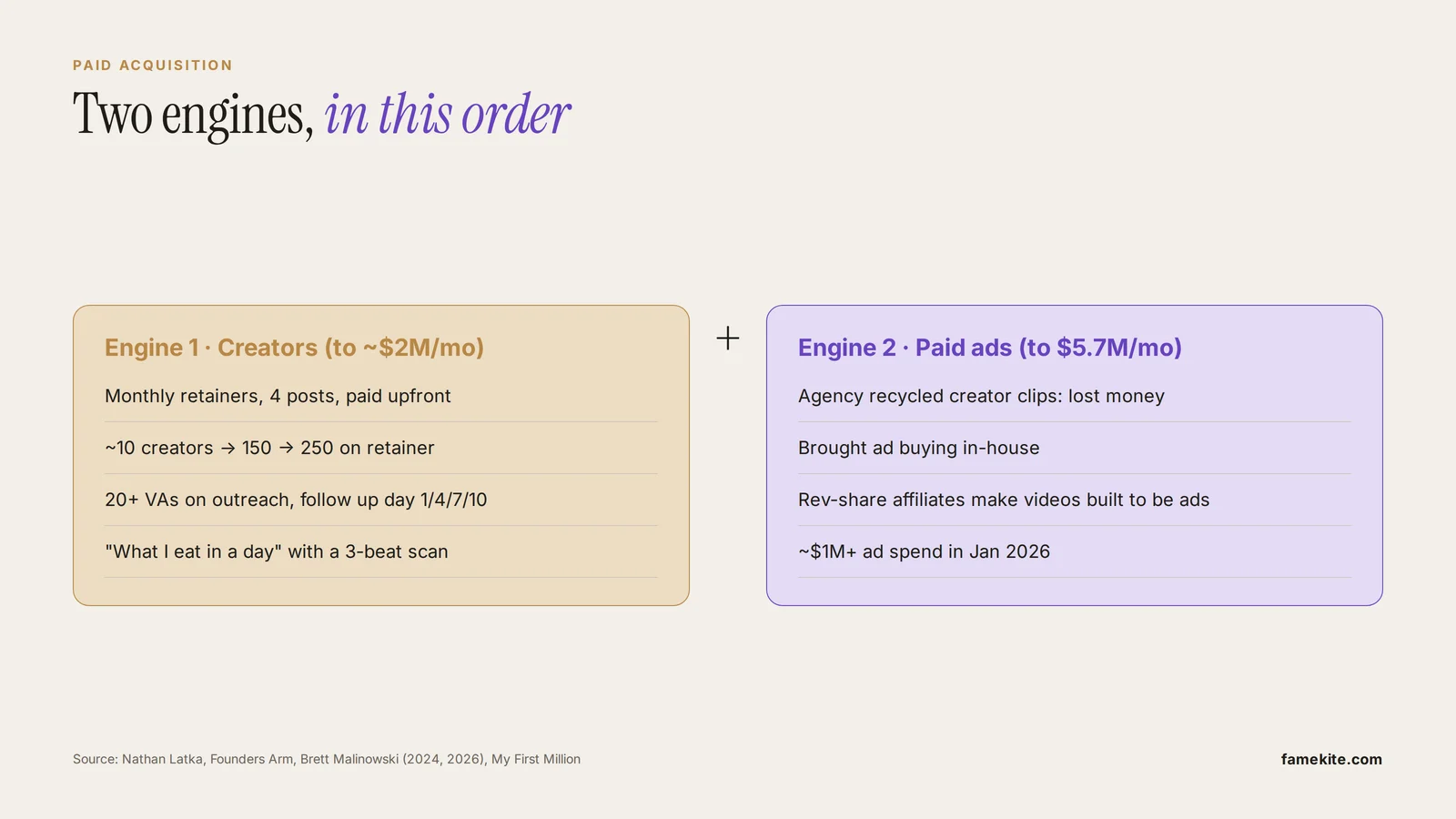
"We got to about $2 million a month just from influencer marketing. After that we kind of plateaued." Zach Yadegari (My First Million)
This was not a few lucky viral posts. It was a system:
- Monthly retainers, four posts a month, paid upfront. Creators usually want paying in advance, so pure pay-per-view deals rarely happen.
- The roster grew from about 10 creators after month one to about 150 by November 2024 and about 250 by June 2025 (Nathan Latka).
- 20+ virtual assistants ran the outreach with follow-ups on day 1, 4, 7 and 10, tracked in a spreadsheet and later Airtable (Founders Arm).
- The format was "what I eat in a day". The creator scans a meal mid-video, often without saying the app's name. The scan shows three results in a row, and the team even removed a streak pop-up from creator builds because a fourth beat broke the rhythm (Sub Club).
- Not every niche works. Bodybuilders and diet creators did. Mukbang creators flopped: their audience does not want to think about calories.
The creator pricing math
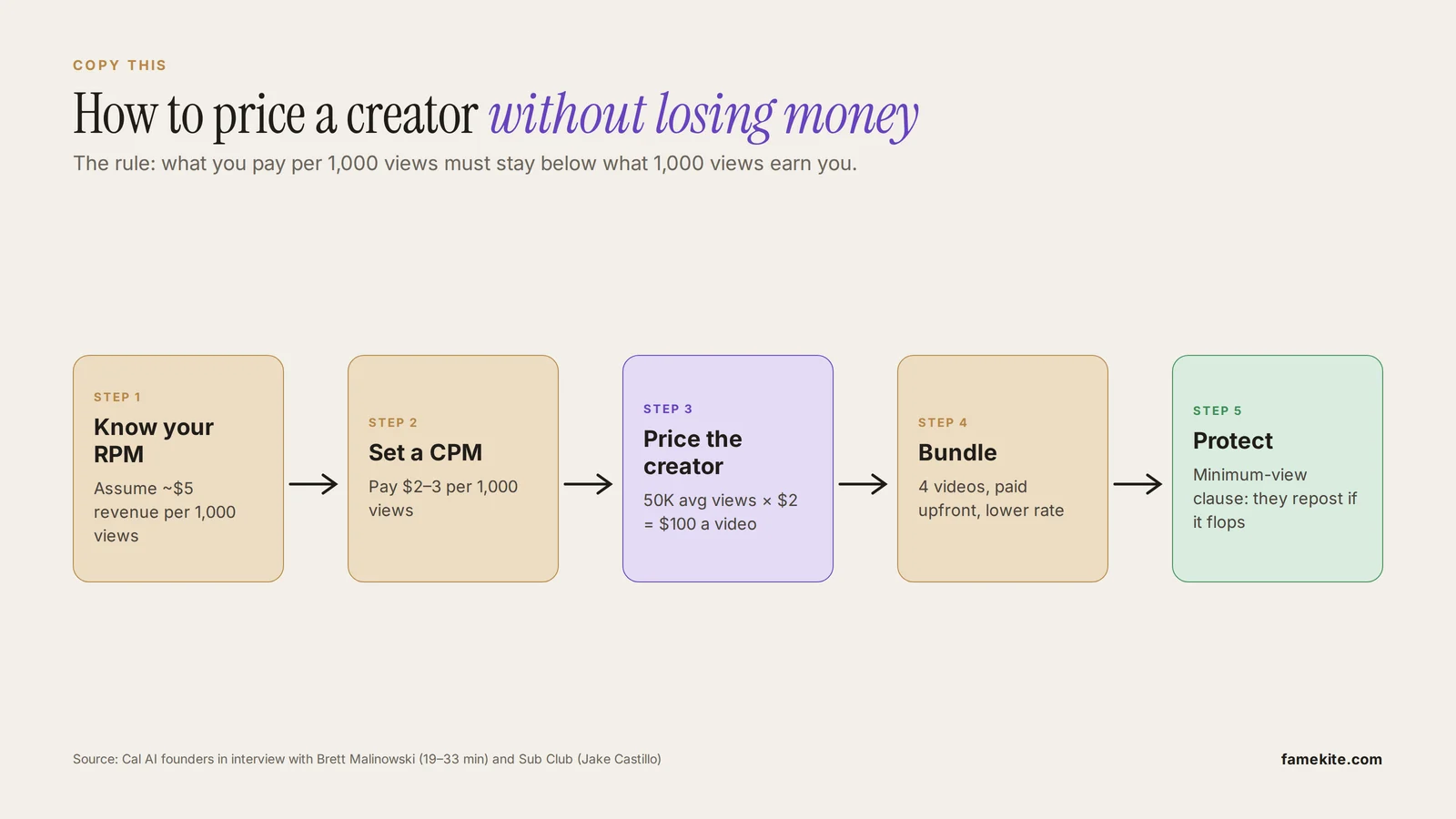
This is the most copyable part of the playbook, described in detail in an interview with Brett Malinowski:
- Estimate what 1,000 views earn you. They started by assuming about $5 of revenue per 1,000 views.
- Pay less than that. Target $2 to $3 per 1,000 views.
- Price the creator from their average views. A creator averaging 50,000 views at $2 per thousand gets an opening offer of $100 a video.
- Bundle and pay upfront: four videos at once for a lower rate.
- Protect yourself with a minimum-view clause: if the posts underperform, the creator keeps posting until they hit the agreed views.
They preferred flat fees over per-view deals. One creator went from about 10,000 views to a 7M-view video in month three; on a flat fee, that spike is pure upside (Sub Club). The most-cited single bet: $500K to sponsor a MrBeast second-channel video, which paid back about $350K to $400K directly and was justified as credibility for later deals.
Engine two: paid ads, after one expensive mistake
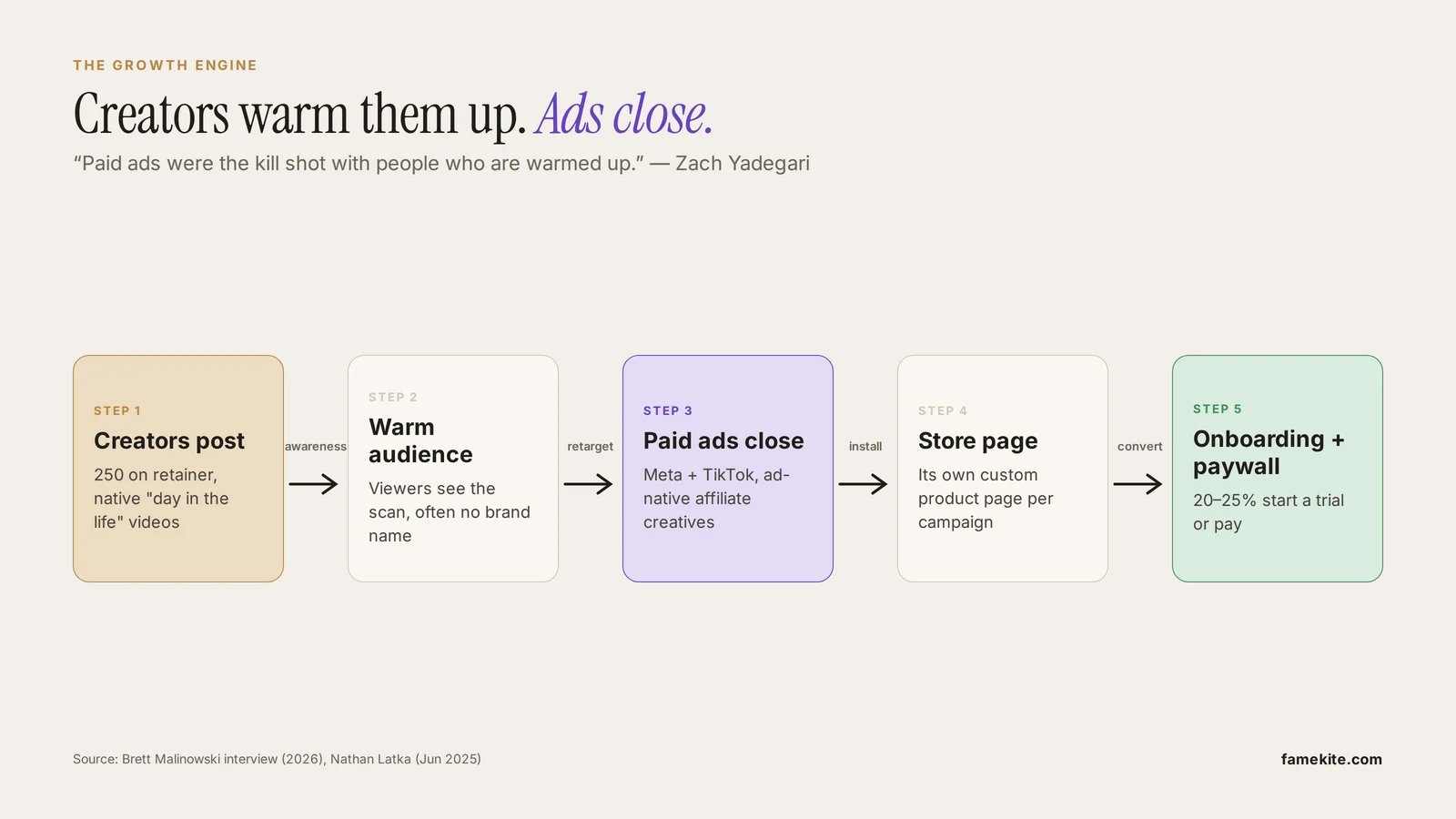
When creators plateaued, Cal AI hired an agency to run ads. The agency re-ran influencer videos as ads, and it lost money. The integrations had been made deliberately subtle, so they did not sell hard enough as ads. Zach took over the buying himself and later built an in-house team (Brett Malinowski).
The fix was creative, not targeting:
- Affiliate creators made videos specifically to run as ads, paid a share of revenue through a platform called Tribe.
- "Most of our videos actually aren't even people talking." The winning format was gym footage and music, then scanning food, with a one-line caption hook.
- Simple campaign structure, lots of creative. Meta's ad library tracker shows Cal AI going from 4 active ads in June 2025 to about 800 by July 2026 (AdWhispr, a third-party estimate).
- Every campaign pointed at its own App Store product page, so paid revenue could be separated from creator-driven revenue.
Ad spend reached "a little over a million" in January 2026. The founders describe paid ads as "the kill shot" on people the creators had already warmed up, and creator spend still ran to a few million a month.
The onboarding and paywall
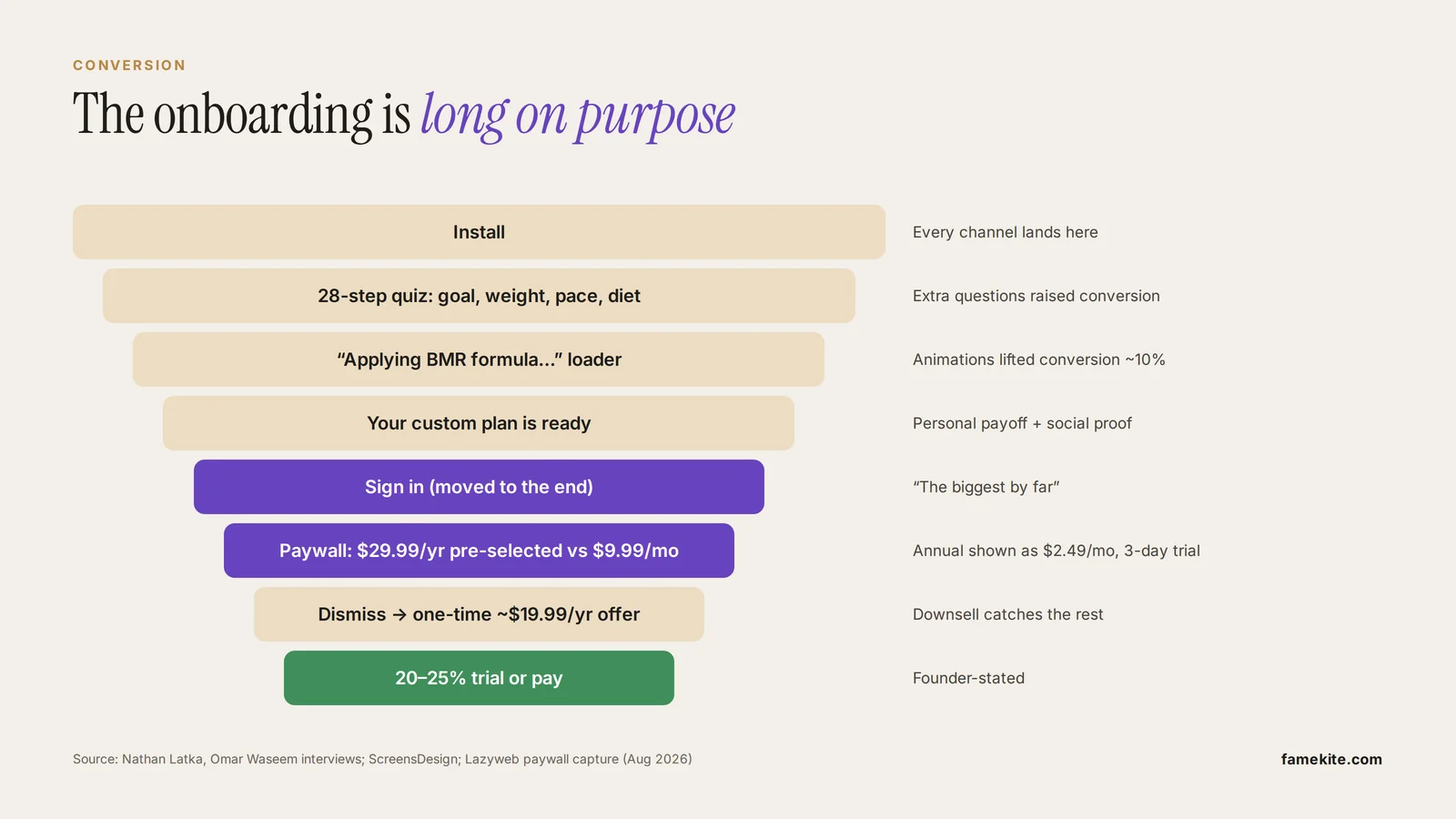
Traffic is only half of it. Cal AI's founders said 20 to 25% of installs started a trial or paid (Nathan Latka). How they got there:
- A long quiz on purpose. About 28 steps: goal, weight, pace, diet, then a "your custom plan is ready" reveal (ScreensDesign). Adding questions that changed nothing still raised conversion, because people value what they invest time in.
- Animations between screens nearly doubled the onboarding length and lifted conversion about 10%.
- Sign-in moved to the end. The founders called it "the biggest by far".
- A hard paywall with the annual plan ($29.99, shown as $2.49 a month) pre-selected next to $9.99 monthly, and a three-day trial (Lazyweb capture). Dismissing it triggered a cheaper one-time offer.
- Constant testing. One full-time hire's only job was paywall experiments.
What went wrong
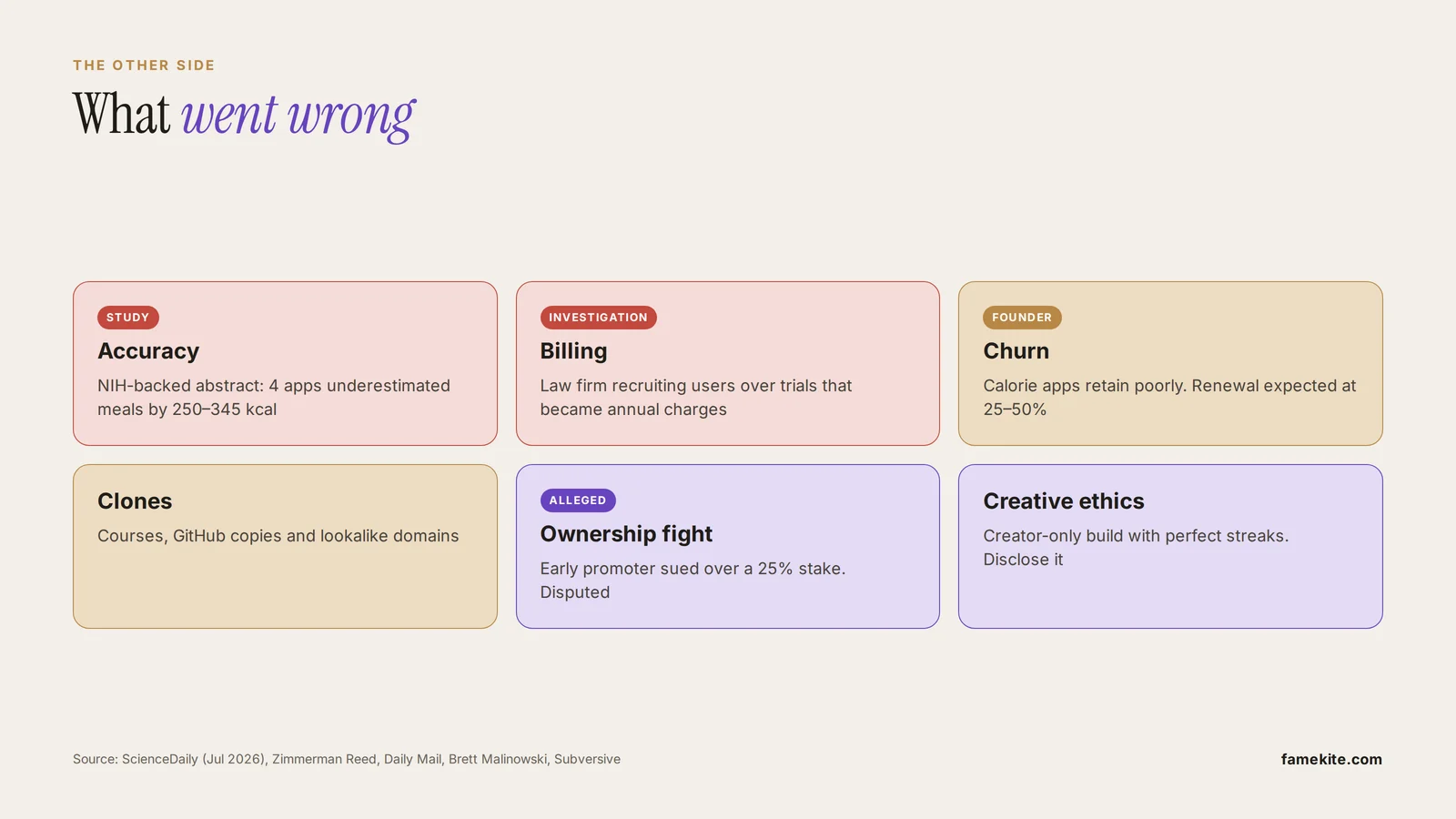
A fair teardown includes the costs:
- Accuracy. A study presented in July 2026 tested 102 lab-prepared meals on four tracking apps, including Cal AI. All four underestimated by 250 to 345 calories a meal (ScienceDaily). These are conference results, not yet peer reviewed.
- Billing complaints. A law firm is recruiting users who say a "free trial" turned into an upfront annual charge (Zimmerman Reed). That is an investigation, not a ruling.
- Retention. Calorie tracking is notorious for churn. The founders expected 25 to 50% of annual subscribers to renew.
- An ownership dispute. An early promoter sued in January 2026 claiming a 25% stake; the founders dispute it (Daily Mail).
- Creative ethics. Creators used a special build showing long streaks so it "looks good on camera". If you copy this, disclosure rules still apply.
What you can copy, and where we help
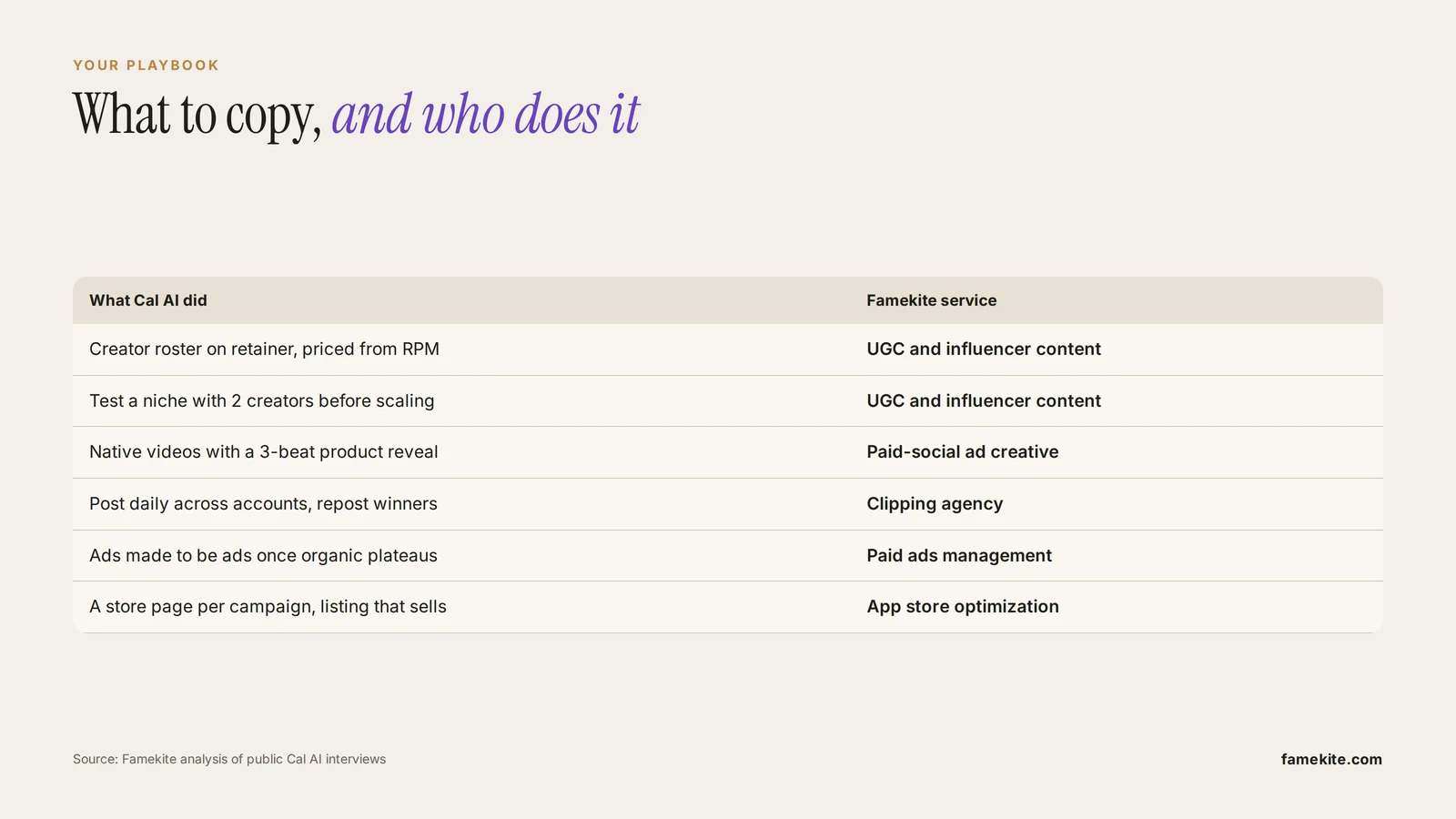
You do not need Cal AI's budget to use its structure. You need a product people can see working in a few seconds, a repeatable way to put it in front of the right creators, and a funnel that converts the traffic.
| Lesson | Where Famekite helps |
|---|---|
| 1. Run a creator roster on monthly retainers, priced from what a view is worth to you. | UGC and influencer content |
| 2. Test a niche with two creators and cheap Story posts before you commit budget. | UGC and influencer content |
| 3. Script native day-in-the-life videos around a reveal that lands in three beats. | Paid-social ad creative |
| 4. Post every day across many accounts, then repost what wins. | Clipping agency |
| 5. When organic plateaus, run paid ads with videos made to be ads, not recycled posts. | Paid ads management |
| 6. Give each campaign its own store page and keep the listing doing the selling. | App store optimization |
| 7. Show the product working in the first seconds, on the screen people will actually use. | App-launch creative |
Onboarding and paywall changes are product work. We can plan the creative and the tests around them, but your team owns the build. For the visual breakdown we used to plan this page, see the Cal AI teardown board on Miro.
Want this working on your app?
Famekite builds the creative engine behind growth like this: ad concepts, UGC and clipping, tested with the same discipline. Book a 15-minute call and we will map what to copy first for your app.
Before you brief us
Did Famekite work on Cal AI?
No. This is an independent teardown built only from public interviews, posts, press releases and store listings. Every figure links to its source.
How much did MyFitnessPal pay for Cal AI?
The price was not disclosed. Figures around $100M come from podcast speculation and unconfirmed reports.
Can a smaller app use the same creator playbook?
The structure scales down: start with two creators, price from what a view is worth to you, and test niches before you add volume. Results depend on whether your product can be shown working in a few seconds.
Are the revenue numbers audited?
No. Most are founder-stated in interviews; a few are third-party estimates and are labelled that way. Gross and net figures also differ, because Apple and Google take a cut.
Free download
Want the worksheets?
Six editable planning tools (brief, script, editor handoff, test planner, launch map, publishing checklist) in one free ZIP.
More free guides
A clear next step
Bring the goal. We’ll discuss the scope.
Share your audience, existing assets and the job you need the creative to do. Deliverables, timing, revisions and any media budget are agreed before work starts.